Sorting through metal 3D printing is confusing when every vendor uses different names. You can group the processes by how they join metal: melting powder, feeding wire, or printing then sintering. Laser powder bed fusion suits detailed parts.
For the bigger picture, see the guide to 3d printing for manufacturing, which this page supports.
| Item | Value |
|---|---|
| ISO/ASTM 52900:2021 process categories | Seven |
| Laser powder bed fusion layer thickness | 20-60 μm |
| Laser power per fibre laser in LPBF | 400-1500 W |
| LPBF powder-bed preheat | ~80-200 °C |
| Electron beam melting powder-bed preheat | ~700 °C |
| Electron beam melting beam energy | ~60 keV |
These figures come from a process taxonomy page dated May 2026. Figures can change between machines and updates, so check the source before you rely on them.
How metal 3D printing processes are grouped
The standard ISO/ASTM 52900:2021 defines seven process categories for additive manufacturing, according to the May 2026 taxonomy. Metal parts come mainly from powder bed fusion, directed energy deposition and binder jetting. Cold spray sits alongside them as a sub-family.
Unlike machining, which starts with a block and cuts away, metal additive manufacturing adds material only where it’s needed, as this overview of metal additive manufacturing puts it. That is why the methods below differ so much in precision, speed and the steps that follow printing.
Powder bed fusion: melting metal powder layer by layer
In powder bed fusion (PBF), a thin layer of metal powder is spread and selectively melted to build the part layer by layer, as the same overview explains. A laser version (LPBF) and an electron beam version (EB-PBF) exist. SLM and DMLS are vendor or legacy terms for LPBF.
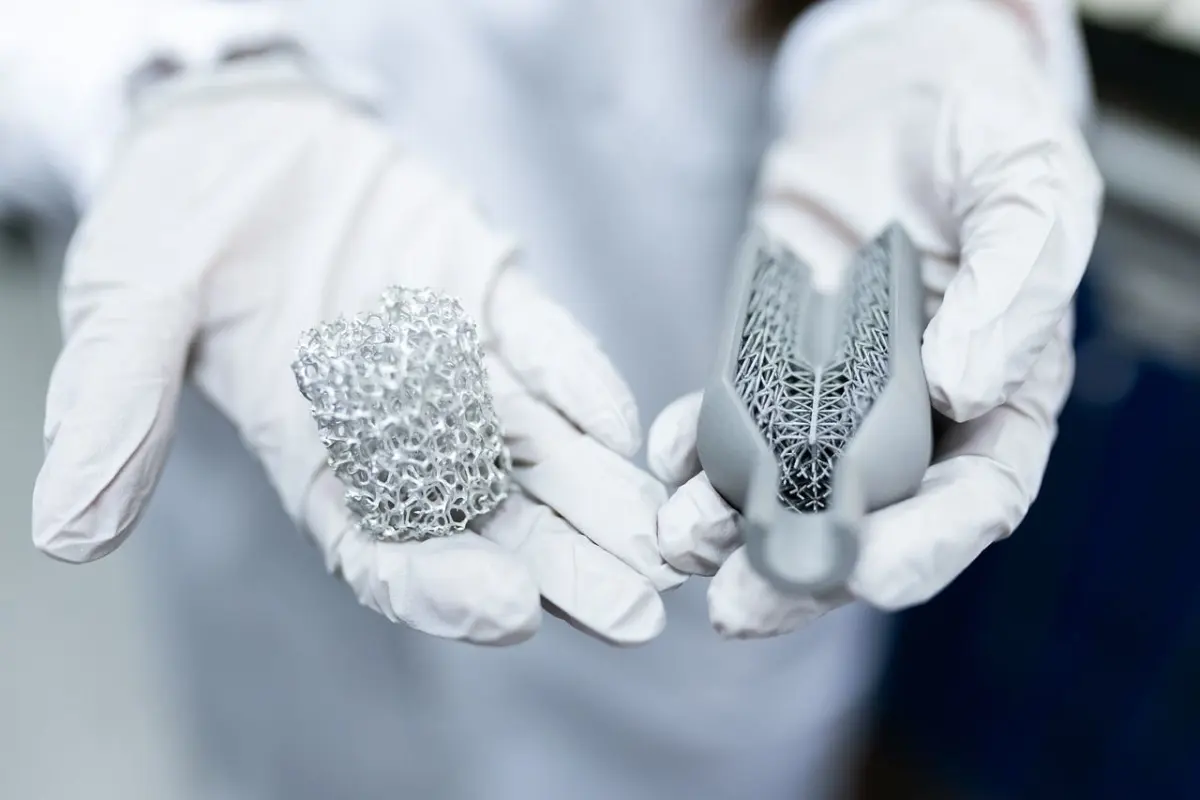
In LPBF, one or more fibre lasers of 400-1500 W melt a 20-60 μm powder layer in an inert atmosphere, per the taxonomy page. The result is dense, highly accurate parts, and the process is a mainstay in aerospace and medical work. Typical materials include:
- Titanium: Ti-6Al-4V
- Aluminium: AlSi10Mg
- Stainless steels: 316L and 17-4PH
- Nickel superalloy: Inconel 718
- Tool steel: H13 for conformal-cooling mould inserts
EB-PBF works in vacuum with a ~60 keV electron beam and a ~700 °C powder-bed preheat, against ~80-200 °C in LPBF (taxonomy page). It yields stress-relieved as-built parts, but with a rougher surface and only for conductive materials. It is well suited to reactive alloys such as titanium, and orthopaedic acetabular cups are the canonical example.
Despite the name, selective laser sintering normally refers to polymer powder, and the overview says not to use it for metals. If you want the polymer side explained, read fdm vs sla vs sls.
Plan for post-processing. Expect support removal and plate separation, and when required hot isostatic pressing (HIP) and machining to meet final tolerances and fatigue requirements. HIP closes internal pores and improves fatigue properties.
Directed energy deposition and WAAM
In directed energy deposition (DED), metal wire or powder is fed into a melt pool created by a focused energy source, then deposited bead by bead. The energy source can be a laser, an electric arc or an electron beam, per the overview.
Laser DED suits feature addition, cladding and repairs. Wire arc additive manufacturing (WAAM) is the arc-based form, with very high deposition rates for large structures.
DED is a natural fit for these jobs:
- Repairing and restoring worn components, such as turbine blades
- Hybrid manufacturing that combines additive and subtractive steps
- Large-scale metal deposition with wire
Binder jetting and metal extrusion: print first, sinter later
Binder jetting prints at room temperature by selectively depositing a liquid binder onto a metal powder bed. The “green” part is then debound and sintered in a furnace, so the design must allow for predictable shrinkage, as the overview notes.
Metal material extrusion (metal FFF) prints a metal-filled filament into a green part that also requires debinding and sintering. It offers a lower-cost path for prototypes and fixtures. Both routes trade laser-induced residual stress for sintering shrinkage.
Cold spray: bonding without melting
In cold spray, particles hit the substrate at supersonic speed and bond without melting (overview). That makes it a solid-state route rather than a melting one.
It enables rapid coatings and restorations with minimal oxidation and heat input. It is used for coatings and dimensional restoration, not for building intricate parts.
Which metal 3D printing process fits your part?
Process selection is matching the physics to the problem, per the overview. Use these rules of thumb:
- Intricate, high-performance parts with internal channels or lattices: LPBF or EB-PBF.
- Large sections and repairs: DED, including WAAM.
- Throughput and cost-sensitive parts that tolerate shrinkage: binder jetting or metal FFF.
- Bonding without melting, such as coatings and restoration: cold spray.
Printing is only one option. If you are deciding whether to print at all, cnc machining vs 3d printing compares the two routes, and many printed metal parts still end with machining.
Frequently asked questions
Is SLS used for metal?
Show answer
Selective laser sintering commonly refers to polymer powder. For metal powder beds, the terms are LPBF (PBF-LB/M) or EB-PBF (PBF-EB/M), as the overview states.
Which process suits titanium?
Show answer
EB-PBF is well suited to reactive alloys such as titanium. LPBF also lists Ti-6Al-4V among its materials, per the taxonomy page.
Why do binder-jetted and metal FFF parts shrink?
Show answer
Both print a green part that goes through debinding and sintering. That furnace step densifies the metal and brings predictable shrinkage, which the design must allow for.
Do printed metal parts need post-processing?
Show answer
Usually. Powder bed parts need support removal and plate separation, and some also need HIP and machining for final tolerances and fatigue requirements, according to the overview.